


FAQ – PRACTICAL TIPS
Frequently asked questions and answers about Barazza products.
SEARCH
Search results: 36
Product ranges
CHARACTERISTICS OF STAINLESS STEEL
Stainless steel is a material that, by its very nature, may show micro-scratches from the very first uses. This is a typical feature and not a defect. These light surface abrasions do not affect the quality, durability, or hygiene of the product in any way. Over time and with use, the surface tends to develop a uniform, lived-in finish that many appreciate for its authentic look.
Yes. Stainless steel may undergo aesthetic changes over time due to usage, cleaning products, or mineral residues in water. These changes are purely cosmetic and do not affect the structural quality, hygiene, or safety of the material, which remains highly resistant and durable.
BARAZZA'S PRODUCTS CLEANING
- After use, rinse well with water and dry with a clean cloth or chamois leather; this operation allows to renew the natural protection of the steel.
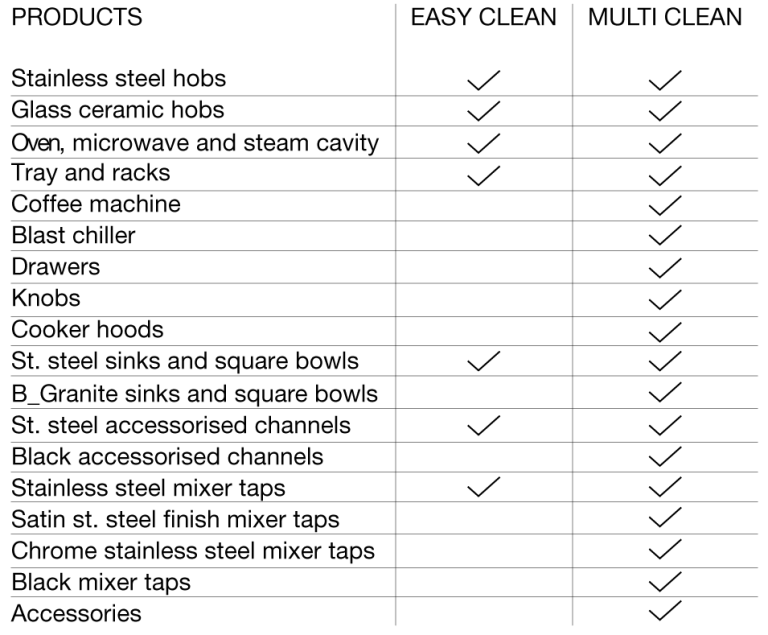
- Use any normal detergent as long as it does not contain chlorine or its compounds, such as bleach and muriatic acid, or the Barazza Multi Clean detergent and the Easy Clean antibacterial microfibre cloth with degreasing and absorbent action. In case of persistent stains, use a little warm white vinegar..
- We recommend using Easy Clean by Barazza, the professional cream that cleans, polishes and protects stainless steel; pour a small amount of product onto a very damp microfibre cloth, rub (for stainless steel with satin finish, follow the direction of the satin finish), rinse thoroughly and dry. Be careful not to drag on cooking residues in order to avoid the formation of micro-scratches on the surface..
- Do not use steel wool or other abrasive materials which will inevitably scratch the steel surface..
- Do not drag objects across the hob but use chopping boards and trivets during normal kitchen operations..
- Avoid placing hot pans, ovens and small ovens on top as they can cause deformation and yellowing.
- Do not leave rusty iron objects on the surface for a long time.
- Do not leave open packages and bottles of detergents or other chemical substances near the product.
- After use, rinse well with water and dry with a clean cloth or chamois leather.
- Do not use steel wool or other abrasive materials which will inevitably scratch the steel surface.
- Do not drag objects across the hob but use chopping boards and trivets during normal kitchen operations.
- Avoid placing hot pans, ovens and small ovens on top as they can cause deformation and yellowing..
- Do not leave rusty iron objects on the surface for a long time.
- Do not leave open packages and bottles of detergents or other chemical substances near the product.
- It is possible to use Barazza Multi Clean detergent or a neutral detergent and the Easy Clean antibacterial microfibre cloth with degreasing and absorbent action daily.
We recommend using Easy Clean by Barazza, the professional cream that cleans, polishes and protects stainless steel; pour a small amount of product onto a very damp microfiber cloth, rinse thoroughly and dry.
The browning (darkening) of the steel grids is a phenomenon due to normal use of the appliance and does not affect its performance, but can be reduced by using the Easy Clean professional cream.
- After the pan supports have cooled, remove and wash them with hot water and dish soap. Stubborn dirt on cast iron components can be removed using a lightly abrasive sponge and degreaser.
- After cleaning, rinse thoroughly, dry very carefully and then reassemble them with the utmost care.
- Occasionally we recommend to wipe the cast iron surfaces (when dry) with a cloth slightly soaked in olive oil.
- Do not wash them in the dishwasher.
- The discoloration of the cast iron elements is a phenomenon due to normal use of the appliance and does not affect its performance.
It is possible to use the Barazza Multi Clean detergent or a neutral detergent and the Easy Clean antibacterial microfibre cloth with degreasing and absorbent action; pour a small amount of product onto a very damp microfiber cloth, rinse thoroughly and dry.
The knobs must not be removed from the pin on which they are mounted: to clean them, we recommend using a soft cloth soaked in a light dose of Barazza Multi Clean detergent or a neutral detergent, making sure there are no infiltrations.
- When cleaning the teppanyaki griddle, it is advisable to clean it while it is still at a temperature of around 50-60 °C, so that food residues can be easily removed.
- If the hotplate is cold, turn the thermostat knob to 50-60°C. If it’s still too hot, wait for it to cool down. In the latter case, in order to find out what temperature the hotplate is actually at, you’ll have to turn the thermostat knob until the pilot light comes on and read the temperature shown on the screen, then turn the knob back to the “0 – Off” position.
- We recommend removing the larger residues from the hotplate using a spatula (and choosing utensils with rounded edges so as to not scratch the plate), wetting the hotplate with a little water and dishwashing detergent or vinegar and leaving them to act for a few minutes to allow the crust to dissolve; in terms of detergents, it’s essential to only use them if they are free of abrasive components and avoid products which are too acidic.
- Then wipe off any residue from the hotplate with a kitchen cloth and water with detergent or vinegar. Rinse the hotplate several times with a cloth moistened with water and dry it carefully.
- Remember that some proteins and acids can stain the hotplate: our advice is to avoid prolonged contact of the hotplate with these substances.
- If the plate is slightly stained, treat the stains with commercial citric acid.
- To clean the hotplate between cooking sessions, simply use a spatula to remove the larger residues and put ice cubes and lemon juice on the hotplate. The ice cubes will melt and soften the deposits, while the lemon will remove the smells of previously cooked food. Once this has been done, remove everything with the spatula.
- The knobs must not be removed from the pin on which they are mounted: to clean them, we recommend using a soft cloth soaked in a light dose of Barazza Multi Clean detergent or a neutral detergent, making sure there are no infiltrations. After cleaning the knob, make sure that you haven’t accidentally moved it from the “0 – Off” position.
- After the grill has cooled, remove it from its housing and wash it with hot water and dish soap. Stubborn dirt on cast iron components can be removed using a lightly abrasive sponge and degreaser.
- After cleaning, rinse it abundantly, dry it very carefully and then reassemble it with the utmost care.
- Occasionally it is advisable to wipe the cast iron surface (when dry) with a cloth lightly soaked in olive oil.
- Do not wash in the dishwasher. The discoloration of the cast iron elements is a phenomenon due to normal use of the appliance and does not affect its performance.
The cast iron grill pan can be cleaned in the dishwasher or with dish soap.
The hood must be cleaned frequently (at least as frequently as maintenance of the grease filters), both internally and externally. We recommend to use Barazza Multi Clean detergent or a neutral detergent and the Easy Clean antibacterial microfibre cloth with a degreasing and absorbent action daily. .
The grease filters must be cleaned once a month (or when the filter saturation indicator system – if provided on the model in possession indicates this need), with non-aggressive detergents, manually or in the dishwasher at low temperatures and on a short cycle.
When washed in the dishwasher, the metal grease filters may discolour but their filtering characteristics do not change at all.
You can use Barazza Multi Clean detergent or a neutral detergent and the Easy Clean antibacterial microfibre cloth with a degreasing and absorbent action daily.
Periodically or if necessary, we recommend the use of Easy Clean by Barazza, the professional cream that cleans, polishes and protects stainless steel; pour a small amount of product onto a very damp microfibre cloth, rub, rinse thoroughly and dry.
You can use Barazza Multi Clean detergent or a neutral detergent and the Easy Clean antibacterial microfibre cloth with a degreasing and absorbent action daily.
Do not use the professional cream Easy Clean.
- After use, rinse well with water and dry with a clean cloth or or chamois leather.
- Only for persistent stains on light-coloured products: use a solution of bleach and lukewarm water and leave for a few hours, then rinse thoroughly and dry.
- Only for persistent stains on dark-coloured products: use a soft sponge and dishwashing liquid, then rinse thoroughly and dry.
- To remove limescale stains we recommend the use of a descaling agent diluted with lukewarm water or warm white vinegar.
- Barazza Multi Clean detergent and Easy Clean antibacterial microfibre cloth with a degreasing and absorbent effect can be used daily.
- Remove any food residues and grease drops from the cooking surface.
- Clean the heated area as best as possible using suitable products and a paper cloth, then rinse with water and dry with a clean cloth.
- Immediately remove fragments of aluminum foil and plastic material that have inadvertently melted or residues of sugar or food with a high sugar content from the heated cooking area with a scraper. In this way, any possible damage to the surface of the hob is avoided. Under no circumstances should scouring pads or irritating chemical cleaners such as oven sprays or stain removers be used.
- It is possible to use Barazza Multi Clean detergent or a neutral detergent or white vinegar and the Easy Clean antibacterial microfibre cloth with degreasing and absorbent action daily.
- For stubborn stains we recommend the use of Barazza Easy Clean professional cream; pour a small amount of product onto a very damp microfibre cloth, rub, rinse thoroughly and dry. Be careful not to drag on cooking residues in order to avoid the formation of micro-scratches on the surface.
Glass ceramic surface
- Remove any food residues and grease drops from the cooking surface.
- Clean the heated area as best as possible using suitable products and a paper cloth, then rinse with water and dry with a clean cloth.
- Immediately remove fragments of aluminum foil and plastic material that have inadvertently melted or residues of sugar or food with a high sugar content from the heated cooking area with a scraper. In this way, any possible damage to the surface of the hob is avoided. Under no circumstances should scouring pads or irritating chemical cleaners such as oven sprays or stain removers be used.
- It is possible to use Barazza’s Multi Clean detergent or a neutral detergent or white vinegar and the Easy Clean antibacterial microfibre cloth with degreasing and absorbent action daily.
- For stubborn stains we recommend the use of Barazza Easy Clean professional cream; pour a small amount of product onto a very damp microfibre cloth, rub, rinse thoroughly and dry. Be careful not to drag on cooking residues in order to avoid the formation of micro-scratches on the surface.
Cooker hood
It is possible to use daily Barazza Multi Clean detergent or a neutral detergent or white vinegar and the Easy Clean antibacterial microfibre cloth with degreasing and absorbent action to clean the upper central insert.
The metal grease filters are used to retain the grease from the cooking fumes, preventing the motor from deteriorating; they can be washed by hand or in the dishwasher. For hand washing, use warm water and soap, brush, rinse with running water and dry carefully. When washed in the dishwasher, the metal grease filters may discolour but their filtering characteristics do not change at all.
It is advisable to wash the grease filters after approximately 40 hours of use of the hob. If the grease filters are very dirty, the motor is able to suck in a small amount of air, with decrease in performance.
Se i filtri antigrasso sono molto sporchi il motore riesce ad aspirare poca quantità d’aria, con diminuzione delle prestazioni.
Ceramic filter (only for filtering extraction)
The ceramic filter achieves an odor reduction of 80%. It is possible to regenerate the filter every 2-3 months until it is intact, by placing it in the oven at a temperature of 150-180° C for 1-2 hours, taking care not to cover the 2 air passage surfaces.
Carbon filter (only for filtering extraction)
Regenerable filter in polyurethane foam, covered with granular activated carbon inserted in a black polyamide (nylon) sheath. Achieves 60% odor reduction. It is possible to regenerate the filter every 2-3 months by washing it in the dishwasher or by hand and before using it again, dry it in the oven at 60° C for 60 minutes. Replace it every 2-3 years.
Stainless steel surface
- After use, rinse well with water and dry with a clean cloth or chamois leather; this operation allows to renew the natural protection of the steel.
- Use any normal detergent as long as it does not contain chlorine or its compounds, such as bleach and muriatic acid, or the Barazza Multi Clean detergent and the Easy Clean antibacterial microfibre cloth with degreasing and absorbent action. In case of persistent stains, use a little warm white vinegar.
- Periodically or if necessary, we recommend using Easy Clean by Barazza, the professional cream that cleans, polishes and protects stainless steel; pour a small amount of product onto a very damp microfibre cloth, rub (for stainless steel with satin finish, follow the direction of the satin finish), rinse thoroughly and dry. Be careful not to drag on cooking residues in order to avoid the formation of micro-scratches on the surface.
- Do not use steel wool or other abrasive materials which will inevitably scratch the steel surface.
- Do not drag objects across the hob but use chopping boards and trivets during normal kitchen operations.
- Avoid placing hot pans, ovens and small ovens on top as they can cause deformation and yellowing.
- Do not leave rusty iron objects on the surface for a long time.
- Do not leave open packages and bottles of detergents or other chemical substances near the product.
Cast iron pan supports and burner caps
- After the pan supports have cooled, remove and wash them with hot water and dish soap. Stubborn dirt on cast iron components can be removed using a lightly abrasive sponge and degreaser.
- After cleaning, rinse thoroughly, dry very carefully and then reassemble them with the utmost care.
- Occasionally we recommend to wipe the cast iron surfaces (when dry) with a cloth slightly soaked in olive oil.
- Do not wash them in the dishwasher. The discoloration of the cast iron elements is a phenomenon due to normal use of the appliance and does not affect its performance.
Stainless steel pan supports
The browning (darkening) of the steel grids is a phenomenon due to normal use of the appliance and does not affect its performance, but can be reduced by using the Easy Clean professional cream.
We recommend using Easy Clean by Barazza, the professional cream that cleans, polishes and protects stainless steel; pour a small amount of product onto a very damp microfiber cloth, rinse thoroughly and dry.
Flame caps
It is possible to use the Barazza Multi Clean detergent or a neutral detergent and the Easy Clean antibacterial microfibre cloth with degreasing and absorbent action; pour a small amount of product onto a very damp microfiber cloth, rinse thoroughly and dry.
Knobs
The knobs must not be removed from the pin on which they are mounted: to clean them, we recommend using a soft cloth soaked in a light dose of Barazza Multi Clean detergent or a neutral detergent, making sure there are no infiltrations.
Glass ceramic surface
- Remove any food residues and grease drops from the cooking surface.
- Clean the heated area as best as possible using suitable products and a paper cloth, then rinse with water and dry with a clean cloth.
- Immediately remove fragments of aluminum foil and plastic material that have inadvertently melted or residues of sugar or food with a high sugar content from the heated cooking area with a scraper. In this way, any possible damage to the surface of the hob is avoided. Under no circumstances should scouring pads or irritating chemical cleaners such as oven sprays or stain removers be used.
- It is possible to use Barazza’s Multi Clean detergent or a neutral detergent or white vinegar and the Easy Clean antibacterial microfibre cloth with degreasing and absorbent action daily.
- For stubborn stains we recommend the use of Barazza Easy Clean professional cream; pour a small amount of product onto a very damp microfibre cloth, rub, rinse thoroughly and dry. Be careful not to drag on cooking residues in order to avoid the formation of micro-scratches on the surface.
Cast iron pan supports and burner caps
- After the pan supports have cooled, remove and wash them with hot water and dish soap. Stubborn dirt on cast iron components can be removed using a lightly abrasive sponge and degreaser.
- After cleaning, rinse thoroughly, dry very carefully and then reassemble them with the utmost care.
- Occasionally we recommend to wipe the cast iron surfaces (when dry) with a cloth slightly soaked in olive oil.
- Do not wash them in the dishwasher. The discoloration of the cast iron elements is a phenomenon due to normal use of the appliance and does not affect its performance.
Flame caps
It is possible to use the Barazza Multi Clean detergent or a neutral detergent and the Easy Clean antibacterial microfibre cloth with degreasing and absorbent action; pour a small amount of product onto a very damp microfiber cloth, rinse thoroughly and dry.
Knobs
The knobs must not be removed from the pin on which they are mounted: to clean them, we recommend using a soft cloth soaked in a light dose of Barazza Multi Clean detergent or a neutral detergent, making sure there are no infiltrations.
External part and accessories
You can use Barazza Multi Clean detergent or a neutral detergent and the Easy Clean antibacterial microfibre cloth with a degreasing and absorbent action daily.
Internal part
We recommend the use of glass, plastic or cling film lids, because this way
- excessive release of steam is avoided (especially with very long cooking times);
- the cooking process is accelerated;
- foods are prevented from drying out;
- the aroma of the dishes is preserved.
The lids must not be airtight, to prevent any type of pressure from building up. Plastic bags must have uniform openings. Baby bottles, baby food jars and similar containers must not be heated with the lid on, otherwise there is a risk of them bursting.
Clean the oven regularly to remove fat or food residues, which can cause stains to appear and cause fumes and odors during subsequent cooking. The enamelled surfaces (for example the base of the oven) must be cleaned when the oven is cold. It is possible to use the Multi Clean detergent by Barazza or a neutral detergent or vinegar and bicarbonate and the Easy Clean antibacterial microfibre cloth with degreasing and absorbent action; pour a small amount of product onto a very damp microfiber cloth, rinse thoroughly and dry.
Do not use sponges or wire brushes, or tools that could damage the enamel.
Over time, some foods such as tomatoes, vinegar, dishes cooked in salt, etc. can cause alterations in the color of the enamel. These variations do not affect its functionality and are to be considered normal. Do not try to remove these stains with detergents or abrasive tools such as those already described, as the surface could be irreversibly damaged. Regularly clean the oven seal to remove grease or food residues. This will prevent the gasket from deteriorating and breaking during subsequent firings. It is recommended to clean the gasket without removing it.
External part and accessories
You can use Barazza Multi Clean detergent or a neutral detergent and the Easy Clean antibacterial microfibre cloth with a degreasing and absorbent action daily.
Internal part
Clean the oven regularly to remove fat or food residues, which can cause stains to appear and cause fumes and odors during subsequent cooking. The enamelled surfaces (for example the base of the oven) must be cleaned when the oven is cold. It is possible to use the Multi Clean detergent by Barazza or a neutral detergent or vinegar and bicarbonate and the Easy Clean antibacterial microfibre cloth with degreasing and absorbent action; pour a small amount of product onto a very damp microfiber cloth, rinse thoroughly and dry.
Do not use sponges or wire brushes, or tools that could damage the enamel.
Over time, some foods such as tomatoes, vinegar, dishes cooked in salt, etc. can cause alterations in the color of the enamel. These variations do not affect its functionality and are to be considered normal. Do not try to remove these stains with detergents or abrasive tools such as those already described, as the surface could be irreversibly damaged. Regularly clean the oven seal to remove grease or food residues. This will prevent the gasket from deteriorating and breaking during subsequent firings. It is recommended to clean the gasket without removing it.
External part
We recommend to use Barazza Multi Clean detergent or a neutral detergent and the Easy Clean antibacterial microfibre cloth with a degreasing and absorbent action daily.
Internal part
Before carrying out any cleaning operation, the machine must be cooled down and disconnected from the mains.
The following parts of the machine must be cleaned periodically:
- Coffee grounds container:
Open the service flap on the front, then remove the drip tray, empty and clean it. Empty and thoroughly clean the coffee grounds container, taking care to remove all residues that may have deposited on the bottom.
- Drip tray: br />
Open the service door. Remove the drip tray and the coffee grounds container. Empty the drip tray and grounds container and wash them. Reinsert the drip tray complete with coffee grounds container. Close the service door.
- Water tank:
Periodically clean (about once a month) the water tank with a damp cloth a little mild detergent. Thoroughly rinse the water tank after cleaning it to remove all detergent residues. Fill with fresh, potable water. Empty the water tank if the appliance is not used for a long time. Replace water if the appliance has not been used for more than two days.
- Spouts of the coffee dispenser, of the cappuccino nozzle, of the cappuccino maker:
Clean the spouts periodically, using a sponge or cloth. Periodically check that the holes in the coffee spout are not blocked. If necessary, remove coffee deposits with a toothpick.
- Funnel for introducing pre-ground coffee:
Periodically check (about once a month) that the funnel for introducing the coffee pre-ground coffee is not clogged. If necessary, remove coffee deposits with a knife.
- The interior of the machine, accessible after opening the service door:
Periodically check (about once a week) that the inside of the machine is not dirty. If necessary, remove coffee deposits with a knife and sponge. Vacuum all residues with a vacuum cleaner.
- The infuser:
The infuser must be cleaned at least once a month. Attention! The infuser cannot be be pulled out when the machine is on. Do not attempt to forcibly remove the infuser as the machine could be damaged. Make sure the machine shut down properly. Open the service door. Remove the drip tray and grounds container. Press the two red release buttons and inwards at the same time pull the infuser outwards. Clean the infuser without using detergents because the inside of the piston is treated with a lubricant which would be removed by the detergent, causing the infuser to stick and become unusable. Immerse the infuser in water for about 5 minutes and then rinse it under the tap. After cleaning, reinsert the infuser by sliding it into the support and onto the pin at the bottom; then press on the PUSH wording until you hear the hooking click.
External part
We recommend to use Barazza Multi Clean detergent or a neutral detergent and the Easy Clean antibacterial microfibre cloth with a degreasing and absorbent action daily.
Internal part
For cleaning, do not use stainless steel wool, scrapers, abrasive, acidic or aggressive substances, which could irreparably damage the surfaces.
To clean the cover and control front, you can use Barazza Multi Clean detergent or a neutral detergent and the Easy Clean antibacterial microfiber cloth with a degreasing and absorbent action daily.
To clean the tank, wait for the sealing bar to cool down. Remove the sealing bar by pulling it upwards. Avoid cleaning the suction opening with water. The water if sucked in could damage the machine. Remove dirt with a soft cloth moistened with warm water. If necessary, use a neutral disinfectant. Dry with a cloth.
To clean the sealing bar, wait for the sealing bar to cool down. Remove the sealing bar by pulling it upwards. Clean with a cloth moistened with warm water. Dry well before using the machine.
To clean the external adapter, use warm water and dish soap. Rinse thoroughly and dry with a clean cloth. Reuse the adapter when it is completely dry.
External Part and accessories
We recommend to use Barazza Multi Clean detergent or a neutral detergent and the Easy Clean antibacterial microfibre cloth with a degreasing and absorbent action daily.
Internal part
Clean the oven regularly to remove fat or food residues, which can cause stains to appear and cause fumes and odors during subsequent cooking. The enamelled surfaces (for example the base of the oven) must be cleaned when the oven is cold. It is possible to use the Multi Clean detergent by Barazza or a neutral detergent or vinegar and bicarbonate and the Easy Clean antibacterial microfibre cloth with degreasing and absorbent action; pour a small amount of product onto a very damp microfiber cloth, rinse thoroughly and dry.
Periodically or if necessary, we recommend using the Easy Clean professional cream by Barazza; pour a small amount of product onto a very damp microfibre cloth, rub, rinse thoroughly and dry. Be careful not to drag on cooking residues in order to avoid the formation of micro-scratches on the surface.
Do not use sponges or wire brushes, or tools that could damage the enamel.
Over time, some foods such as tomatoes, vinegar, dishes cooked in salt, etc. can cause alterations in the color of the enamel. These variations do not affect its functionality and are to be considered normal. Do not try to remove these stains with detergents or abrasive tools such as those already described, as the surface could be irreversibly damaged. Regularly clean the oven seal to remove grease or food residues. This will prevent the gasket from deteriorating and breaking during subsequent firings. It is recommended to clean the gasket without removing it.
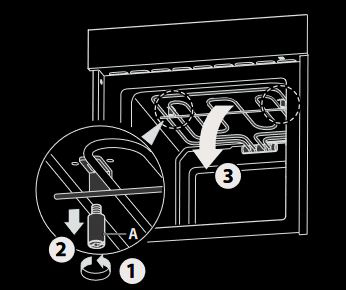
To make cleaning the inside of the oven easier, you can:
- remove the side grilles for the cooking levels: if they include removable guides (optional) it is NOT advisable to wash them in the dishwasher as this could jeopardize their correct functioning;
- lower the tilting ceiling resistance by unscrewing the two pins
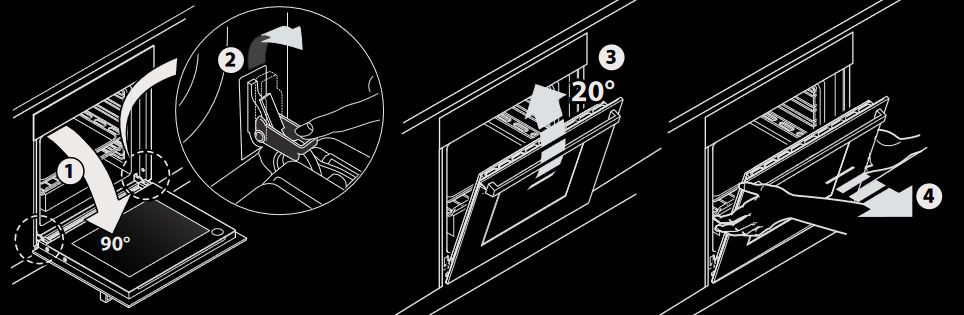
- remove the oven door, follow operations 1 to 4, carry out the operations to reposition it in the reverse.
- After using, clean the trencher with a damp cloth.
- Never immerse in water.
- To dry it keep in upright position so that the two faces are exposed to the air.
- Never dry the trencher indirect sunlight or on hot surfaces (radiators, stoves, ecc.)
- If the trencher bends, put the concave part on a level surface.
- To avoid absorbing of water, keep it oiled regularely using alimentations-oil.
- Chopping boards can be cleaned with a non-abrasive sponge, or in the dishwasher up to 70 degrees Celsius..
- To disinfect them, they can be immersed in a solution of water and gentle disinfectant.
- Rinse thoroughly.
- Never dry the trencher indirect sunlight or on hot surfaces (radiators, stoves, ecc.)
We recommend to use Barazza Multi Clean detergent or a neutral detergent and the Easy Clean antibacterial microfibre cloth with a degreasing and absorbent action daily.
- Rinse the bowl cover
- Spray the Multiclean product or a neutral detergent on the microfibre cloth
- Wipe all surfaces of the bowl cover
- Rinse and dry thoroughly
We recommend to use Barazza Multi Clean detergent or a neutral detergent and the Easy Clean antibacterial microfibre cloth with a degreasing and absorbent action daily.
- Rinse the bowl cover
- Spray the Multiclean product or a neutral detergent on the microfibre cloth
- Wipe all surfaces of the bowl cover
- Rinse and dry thoroughly
The material is non-porous: dirt and bacteria remain on the surface and are easy to remove.
It can be sanitised with:
-
hot water
-
steam
-
all common disinfectants used in domestic/professional settings (if used according to the label).
Precautions:
Avoid very strong acidic or alkaline solutions (e.g. drain openers, hydrochloric acid, caustic soda, etc.), as they may stain the surface.
In case of accidental contact with very aggressive products, rinse immediately with plenty of water.
BARAZZA'S PRODUCTS USE
Instructions for use:
Place the pizza stone on the rack, halfway up the oven, with the oven switched off.
Start the oven using the rapid preheating mode for 20 minutes, setting the temperature required for baking the pizza (between 220°C and 270°C). After 20 minutes, the stone will be sufficiently hot. It is recommended to place and remove the pizza quickly to keep the temperature stable.
Thanks to its ability to absorb and distribute heat evenly, the stone ensures optimal baking, giving the pizza a crispy crust.
After use:
Leave the stone inside the oven until it has completely cooled down. If it is necessary to remove it while still hot, use oven gloves to avoid burns.
Clean the surface by removing any food residues with a damp cloth soaked in water and vinegar or dishwashing detergent. The stone is dishwasher-safe. For stubborn stains, Easy Clean can be used, taking care to rinse thoroughly.
Tips for use:
In addition to pizza, the stone is ideal for preparing bread, focaccia, meat, fish, vegetables and other dishes.
The stone can be used as a serving base at the table, keeping food warm. The use of heat-resistant gloves and a support such as the oven rack or a trivet is recommended to protect surfaces.
Avoid placing the stone on sensitive materials, such as stainless steel, to prevent scratches or deformation caused by heat.
-
It is a compact, non-porous and chemically stable high-pressure laminate (HPL).
-
Suitable for food contact: it does not release substances onto food.
-
The surface is easy to sanitise with hot water, steam and common disinfectants used in domestic and professional settings.
Therefore, it is suitable as: a work surface for cold foods, foods at room temperature or lukewarm foods.
Hot / cold use
The material does not melt, but it can begin to thermally degrade above 250°C and only burns in the event of a fire at around 400°C; this means it withstands moderate heat well, but it is not intended as a direct support for very hot items.
Do not place directly:
-
pots just removed from the flame or the induction hob
-
baking trays just taken out of the oven
-
always use a trivet, pot holder or an intermediate base to avoid marks, swelling or permanent damage.
Cold foods and room temperature
No issues for cold or frozen foods, doughs, pastry preparations.


